In short
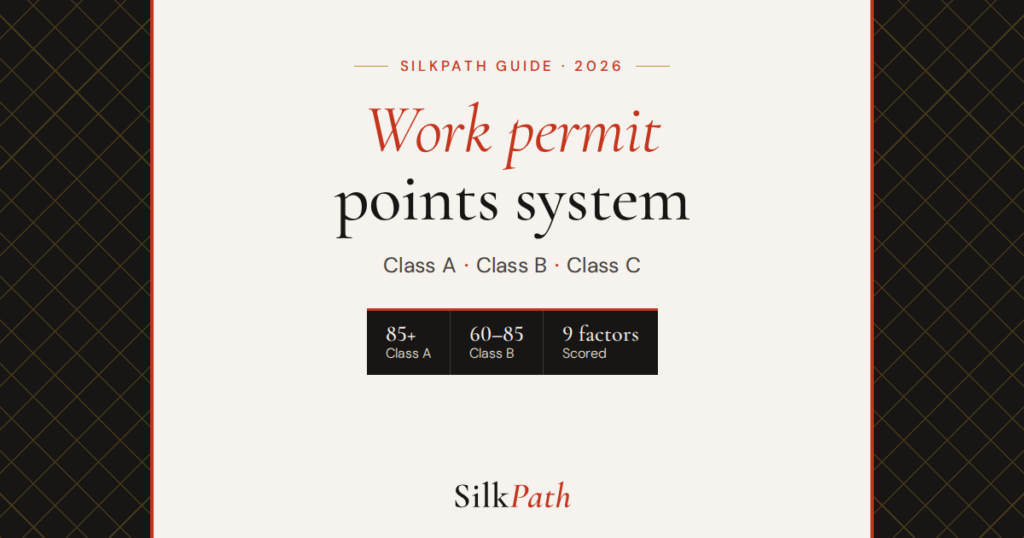
China sorts foreign workers into three work permit classes. Shanghai’s government says Category A needs at least 85 points and Category B 60 to 85 points; its older FAQ puts Class A at 86 and above and Class C at 59 or below. Points come from salary (up to 20), education (up to 20), relevant work experience (up to 20), age, Chinese language and other factors. Check the exact table with your employer or the local foreign-expert office, because cut-offs are not the same in every source.
Last updated: 22 October 2026. This guide is based on two pages published by the Shanghai government (August 2026 and an undated FAQ) and on a 2017 explainer. Scoring tables can change and differ by city. It is general information, not legal advice: confirm your own score with your employer, the local foreign-expert office or the Chinese embassy or visa centre in your country.
How does China’s work permit points system work? China sorts foreigners who want to work in the country into three classes, A, B and C. Shanghai’s government says Category A needs at least 85 points and Category B 60 to 85 points, and its older FAQ adds that Class C is 59 points or below. Points come mainly from your annual salary, your degree and your years of relevant experience, each worth up to 20 points, plus smaller items such as age, Chinese language and where you work. Some people skip the scoring and are placed directly in a class.
The exact numbers matter less than knowing where you stand before you accept a job offer. This guide explains the three classes, the scoring table, a worked example, and what the official pages do not tell you.
China work permit points system: the three classes
The system started as a pilot in 2016 and went nationwide in 2017, according to China Briefing’s 2017 explainer by Dezan Shira & Associates. It replaced the older permits with one work permit sorted into three tiers. That article is dated, so we use it for the logic of the system and not for current figures.
| Class | Points (Shanghai, 2026 page) | Points (Shanghai FAQ, undated) | Who it is meant for |
|---|---|---|---|
| A | at least 85 | 86 and above | Top talent, also placed directly by criteria |
| B | 60 to 85 | 60 to 85 | Most professionals |
| C | not defined on the page | 59 and below | Short stays and quota-limited roles |
Two things stand out. First, the two Shanghai pages disagree on 85 points: the 2026 guide says “at least 85” for Category A and “60 to 85” for B, while the FAQ says Class A starts at 86. Neither page resolves it, so treat 85 as the line to aim above. Second, the 2026 guide says “Category” and the FAQ says “Class”. They mean the same thing.
What does each class mean in practice? China Briefing (2017) describes Tier A as a “green channel” with faster approval and paperless checks, Tier B as the normal route with original paper documents and approval controlled according to labour-market demand, and Tier C as subject to quotas, longer processing and short permit validity. It estimated the split at about 16% A, 61% B and 22% C of expats in 2017. We could not find a current official split, so do not read those percentages as 2026 data.
How the points are counted
The most useful official source is Shanghai International Talent’s guide, published on 13 August 2026 on the Shanghai government’s English site. It covers five commonly used scoring items. The FAQ lists nine factors in total.
Salary (up to 20 points)
This is the annual salary paid by your employer in China.
| Annual salary (RMB) | Points |
|---|---|
| 450,000 or more | 20 |
| 350,000 to under 450,000 | 17 |
| 250,000 to under 350,000 | 14 |
| 150,000 to under 250,000 | 11 |
| 70,000 to under 150,000 | 8 |
| 50,000 to under 70,000 | 5 |
| below 50,000 | 0 |
The employer and the applicant jointly submit a Salary Commitment Form, signed by the applicant and stamped by the employer. Tax records are needed later for extensions and cancellations, so the salary on paper has to match what you are really paid.
Education (up to 20 points)
Only your highest degree counts: a doctorate scores 20, a master’s degree 15 and a bachelor’s degree 10. Overseas degrees must be authenticated by a Chinese embassy or consulate, by the embassy or consulate of the awarding country in China, or by a recognised Chinese credential verification body.
Relevant work experience (up to 20 points)
Less than two years scores 0, two years scores 5, and each extra year adds one point up to the 20-point cap. Shanghai’s example: 10 years gives 13 points, and 17 years gives the maximum of 20. The experience must be relevant to the job you will do in China, and former employers must issue documents that state your position and dates, with a seal or authorised signature and a contact phone number or email.
Chinese language (up to 5 points)
HSK 5 or above scores 5, HSK 4 scores 4, HSK 3 scores 3, HSK 2 scores 2 and HSK 1 scores 1. A bachelor’s degree or above taught in Chinese also scores 5. Only one criterion counts.
Additional qualifications (up to 5 points)
Only one counts, each worth 5: graduating from a qualifying high-level university outside mainland China, working for a Fortune Global 500 company, holding intellectual property such as patents, or having worked continuously in China for at least five years.
Other factors in the FAQ
The undated Shanghai FAQ lists four more items that the 2026 guide does not score: annual time worked in China (up to 15 points, with 9 months or more scoring the maximum), working area (up to 10 points for western China, the northeast, old industrial regions and some poorer counties), age (up to 15 points, with 26 to 45 scoring the most and over 60 scoring 0) and provincial bonus points (0 to 10 for locally needed talent).
A worked example
Take a 28-year-old with a master’s degree, five years of relevant experience and a job in Shanghai paying RMB 300,000 a year, with no Chinese and no other qualifications. Using the 2026 guide’s tables:
- salary: 14 points
- education: 15 points
- experience: 5 points for the first two years, plus 3 for the next three, so 8 points
- Chinese: 0
- additional qualifications: 0
That is 37 points from these five items alone. The FAQ adds age (26 to 45 scores the maximum of 15) and annual work duration (up to 15), but neither page explains how the final total is calculated, so ask your employer to run the real calculation. This is only an illustration built from the published tables, not an official result.
Direct placement: people who skip the scoring
The Shanghai FAQ lists three direct-assignment routes with no points shown: people selected for national talent plans or meeting internationally recognised standards of contribution, people filling government-encouraged posts, and innovative and entrepreneurial talent or outstanding young talent. China Briefing (2017) lists more detailed criteria for Tier A and Tier B, including pay above six times (A) or four times (B) the local average salary, and a specific rule for foreign-language teachers: a bachelor’s degree and two years of teaching experience, with the two years waived for people with an education or language degree or another recognised teaching certificate.
We could not confirm those 2017 criteria on a current official page, so do not rely on them. If you are a teacher, read teaching English in China in 2026 and ask your school which class it will apply for.
What the official pages do not say
- Validity. Neither Shanghai page states how long a permit lasts in each class. China Briefing only says B and C permits may be issued with shorter validity than A.
- Minimum requirements. Neither Shanghai page sets a minimum degree, age or experience. They only describe scoring.
- How to combine the factors. The FAQ lists nine factors but does not say whether all of them are added together or whether some are exclusive.
- Other cities. The pages are from Shanghai. Provinces set their own bonus points, so Beijing, Shenzhen or Chengdu may differ.
What this means if you are looking for a job
In practice, your employer files the application, and the class it lands in depends on your salary, degree and years of experience. A higher salary and a longer record help, but the points are only part of the picture: you still need the right visa, a clean criminal record check and apostille and an employer who can sponsor you. Our step-by-step guide to the China work visa covers the whole process, and how to get a job in China as a foreigner explains where to look.
Some numbers from our own data. On 22 October 2026, SilkPath listed 461 live jobs, and our feed added 82 new LinkedIn and 16 new Jooble listings in the previous seven days. In our 20 October analysis of 285 LinkedIn descriptions, 13 stated explicitly that the employer sponsors a visa. Our job feed does not give us reliable salary figures, so we cannot tell you which jobs reach a given class. Browse jobs in Shanghai, Chengdu or the full China jobs list and ask each employer about the work permit before you sign.
FAQ
What is the China work permit points system?
It is the system that sorts foreign workers into Class A, B or C. You earn points for salary, education, work experience, age, Chinese language and other factors, and your total decides the class. Some people are placed directly by criteria without scoring.
How many points do I need for a China work permit?
Shanghai’s government says Category A needs at least 85 points and Category B 60 to 85. Its older FAQ puts Class A at 86 and above and Class C at 59 or below. Ask your employer which table applies in your city.
Does speaking Chinese help my work permit score?
A little. Chinese language is worth up to 5 points in the Shanghai tables, for example 5 points for HSK 5 or above. China Briefing (2017) said Mandarin has a negligible effect on the class you end up in.
Is the work permit class the same as the Z visa?
No. The work permit is the approval to work, sorted into classes. The Z visa is the entry visa you use to travel to China to work. Read our work visa guide for how they fit together.
Do I need a degree to get a China work permit?
The Shanghai pages do not set a minimum degree: they only score education. A bachelor’s degree is worth 10 points. China Briefing (2017) said a bachelor’s degree and two years of relevant experience should be enough to qualify for Tier B in most cases. Check the current rule with your employer or the embassy or visa centre.
Sources
- Shanghai International Talent, “Understanding China’s work permit points system”, Shanghai government English site, 13 August 2026: english.shanghai.gov.cn
- Shanghai government FAQ, “What is the Points-based System for the Foreigner’s Work Permit?” (undated page, address suggests December 2023): english.shanghai.gov.cn
- Dezan Shira & Associates, “China Work Permits: Are You an A, B, or C Tier Talent?”, China Briefing, 19 July 2017 (dated: used for the logic of the system only): china-briefing.com