In short
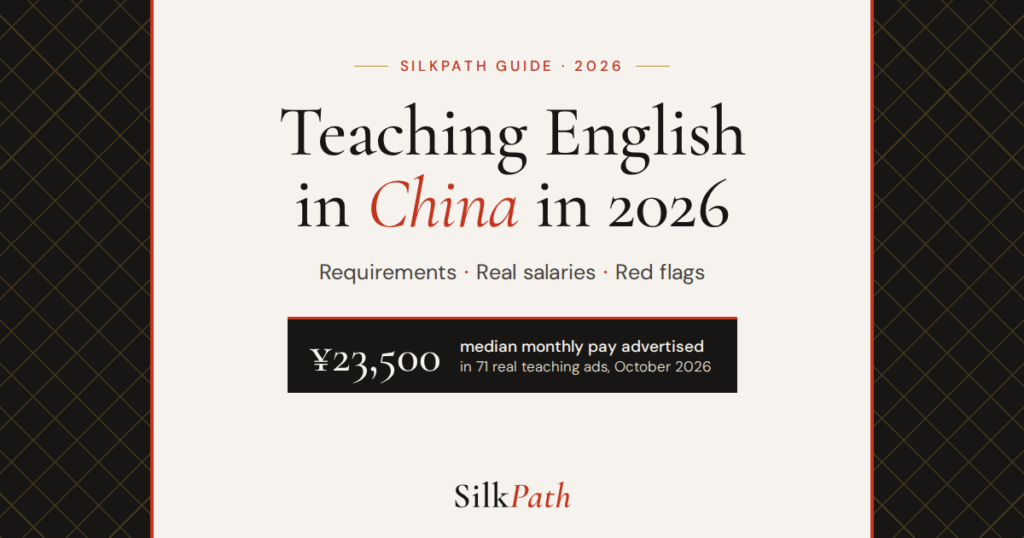
To teach English legally in China, you need a bachelor’s degree, a passport from a country where English is native (in practice the US, UK, Canada, Australia, New Zealand, Ireland or South Africa), a clean criminal record and usually a TEFL, with a work permit and Z visa sponsored by your school. In 71 teaching ads with a stated salary on SilkPath (9–15 October 2026), the median was ¥23,500 a month, from ¥15,000 at universities to ¥25,500 for subject teachers in international and bilingual schools. Never start teaching on a tourist visa or visa-free entry.
Last updated: 19 October 2026. Visa and work-permit rules in China change often and can vary by city. Use this article as a starting point, and always confirm the current requirements with your employer and the Chinese embassy or visa centre in your country.
Teaching English is still the most common way for Westerners to start a career in mainland China, and China remains one of the main destinations for people who want to teach English abroad. It is also the part of the market where the gap between online advice and reality is widest: requirements that used to be flexible are now checked by a national online system, and salaries vary far more by city and type of school than most guides admit.
This guide covers three things: what you legally need to teach in China in 2026, what schools are actually advertising in pay right now (based on real listings on SilkPath), and the red flags that should make you walk away.
1. The requirements to teach English in China
To teach legally, you need a work permit and a Z (work) visa, sponsored by a licensed employer. China’s rules for foreign language teachers, as reported by Chinese state media when the State Administration of Foreign Experts Affairs set them out, ask for:
- Native-speaker status in the language you teach.
- A bachelor’s degree or higher (any subject for most English roles).
- Two years of relevant teaching experience. In practice, many employers and local authorities accept a recognised TEFL certificate (or TESOL or CELTA, usually at least 120 hours) instead of experience for entry-level roles, and many ask for one anyway. Ask your employer how the rule is applied in your city.
- A clean criminal record, proven by a national background check from your home country.
What “native speaker” means in practice. For English, employers and local authorities generally require a passport from one of seven countries: the United States, the United Kingdom, Canada, Australia, New Zealand, Ireland or South Africa. This list comes from how the rule is applied rather than from a published official list, so check your own case with your employer before you sign. If you hold two nationalities, it is the passport you apply with that counts.
Documents must be authenticated. Your degree, your teaching certificate and your criminal record check usually need an apostille (or, for some countries, legalisation) in your home country. The background check is normally expected to be recent, often issued within the last six months. Long hiring negotiations can make it expire, so ask your employer early which documents they need and in which order.
For the full picture of China’s work visas (Z, the new K visa for STEM talent, visa-free entry and the internship trap), see our China visa guide and our step-by-step work visa article.
2. From job offer to legal teacher: the steps
The process usually runs in three stages. Your employer handles most of the online part, but the documents and the deadlines are yours.
- Before you fly: work permit notice. Your school applies online for your work permit using your documents. Once approved, it sends you a notification letter and an invitation.
- In your home country: the Z visa. You apply at the Chinese embassy, consulate or visa application centre. The Z visa gets you into China; it is not the long-term permit itself.
- After you land: work permit and residence permit. You register your address with the local police (hotels do it for you), complete a medical check at a designated clinic, collect your work permit, and apply for your residence permit. China’s Exit and Entry Administration Law sets a deadline of 30 days from entry to apply for the residence permit when your visa requires one, and local government guides for foreign employees give the same 30-day window for the work permit.
The one rule never to break: do not start teaching on a tourist visa, a business visa or visa-free entry, even “just while the paperwork is sorted”. That is illegal employment in China, and the penalties (fines, detention, deportation, re-entry bans) fall on you.
3. What teaching jobs in China pay in 2026
Most salary figures online are old or come from a single recruiter. Instead, we looked at the teaching jobs listed on SilkPath that state a monthly salary in yuan: 71 ads posted between 9 and 15 October 2026. For each ad we took the middle of the advertised range. It is a snapshot, not a survey, but every number comes from a real listing.
| Type of role | Ads | Typical monthly pay (middle half of ads) | Median |
|---|---|---|---|
| Subject teachers in international and bilingual schools | 29 | ¥23,000–29,250 | ¥25,500 |
| Kindergarten and early years | 22 | ¥22,250–26,125 | ¥23,750 |
| Training centres and language schools (ESL) | 9 | ¥17,000–26,750 | ¥22,500 |
| Universities and colleges | 10 | ¥12,250–17,500 | ¥15,000 |
| All teaching ads | 71 | ¥17,500–27,500 | ¥23,500 |
Source: SilkPath job board, teaching ads with a stated monthly salary in CNY, posted 9–15 October 2026 (management roles such as principals and coordinators excluded). Advertised ranges, usually before tax; ads do not always say whether housing is included.
What stands out:
- Universities pay less in cash but often come with lighter teaching hours, long holidays and, frequently, campus housing. Compare the whole package, not the monthly figure.
- Kindergartens and bilingual schools make up most of the market and pay in a fairly tight band, typically above ¥20,000 a month.
- Hourly work exists (we saw ads from ¥200 to ¥800 an hour), but part-time teaching still needs a work permit tied to an employer. A side job without one is illegal work.
- The city changes everything. The median ad was around ¥25,000 in Beijing (15 ads) and ¥24,000 in Chengdu (8 ads), but rent and daily costs differ hugely between them. Our cost of living guide, based on China Briefing’s 2026 survey, puts a local-lifestyle budget at ¥8,000–12,000 a month in Shanghai against ¥4,500–7,000 in Chengdu.
4. What to check in a contract
- Who your legal employer is. Many ESL teacher ads are posted by recruiters. Your work permit must be sponsored by the school or company you will actually work for, in the city where you will work.
- Teaching hours and office hours, per week, written down.
- Housing: provided, or a monthly allowance, and how much.
- Flights (airfare or an airfare allowance) and contract-completion bonus: when they are paid, and under which conditions.
- Health insurance: who pays, and what it covers.
- Paid holidays, including Chinese public holidays.
- Visa costs: who pays for document authentication, the medical check and the permits.
- Notice period and penalties if either side ends the contract early.
5. Red flags: when to walk away
- 🚩 “Come on a tourist visa, we’ll change it later.” A Z visa is applied for from outside China after the work permit notice. Starting work first is illegal.
- 🚩 “You don’t need a degree or a TEFL, we have connections.” The work permit system checks documents; connections do not replace them.
- 🚩 “Your passport doesn’t matter.” If you don’t hold one of the passports usually accepted for English teachers, ask how exactly the school will get your work permit approved, and in writing.
- 🚩 Salary in cash, or no written contract. No contract means no legal protection and no visa renewal.
- 🚩 The school asks to keep your passport. It may need it briefly for the residence permit application, but should not hold it otherwise.
Finding a teaching job in China: where the teaching positions are
Most English teaching positions in China are in kindergartens, bilingual and international schools, training centres (private language schools) and universities, as the salary table above shows. If you are choosing a TEFL course, check that it states at least 120 hours, since that is what many employers ask for; a TESOL certificate or a CELTA is accepted in the same way. Some ESL jobs include free housing or a housing allowance: get it in writing. Private tutoring is not a legal side job: as a language teacher, your work permit covers the employer that sponsors it.
Compare teaching opportunities between cities with Shanghai vs Chengdu cost of living, and if you are considering teaching abroad elsewhere in Greater China, read teaching English in Taiwan or the Hong Kong work visa guide. Your criminal record check and apostille is usually the slowest document, and our guide to internships in China for foreigners explains the rules if you are still a student. Considering an au pair year? Read is au pair legal in China first.
FAQ
Can I teach English in China without a degree?
Not legally. A bachelor’s degree is required for the work permit for foreign language teachers.
Is an online TEFL accepted?
Often yes, if the certificate states at least 120 hours and can be authenticated. Some employers and local offices are stricter about online-only certificates, so check before you pay for one.
Can non-native speakers teach English in China?
Generally not for English, under the current rules and how they are applied. Non-native speakers can sometimes teach other subjects (maths, science, art, PE) in international schools, with relevant qualifications and experience.
How long does the whole process take?
Plan for at least two to three months between accepting an offer and starting work, mostly because of document authentication and the work permit approval.
Can I teach in Hong Kong or Taiwan instead?
Yes, with different rules. See our Hong Kong guide and Taiwan guide.
Find teaching jobs in China
SilkPath lists new teaching roles every day, from kindergartens to universities, with the salary when the employer gives it. Browse teaching jobs in Greater China, or start with a city: Beijing, Shanghai, Shenzhen, Guangzhou.
Teaching ads are also posted outside SilkPath: our top 10 job boards for expats in China explains where else to look, and which channels move fastest.
And if you’d rather have the best new roles sent to you, join the free SilkPath newsletter: one email every Monday, unsubscribe anytime.
Sources
- China Daily (2019), reporting the State Administration of Foreign Experts Affairs requirements for foreign language teachers: global.chinadaily.com.cn
- Exit and Entry Administration Law of the PRC, Article 30 (residence permit within 30 days of entry), official English text published by the National Immigration Administration: en.nia.gov.cn
- Beijing Municipal Government, A Guide to Working and Living in China as Business Expatriates (work permit within 30 days of entry): english.beijing.gov.cn
- National Immigration Administration of China: en.nia.gov.cn
- Salary data: SilkPath job board, 71 teaching ads with a stated monthly salary, 9–15 October 2026.