In short
There is no general internship visa in China: an internship counts as work, even unpaid. The legal routes are an “internship” remark on the residence permit for students at Chinese universities, organised programmes or pilot schemes for students abroad, and a regular work permit for recent graduates. Interning on a tourist visa, a business visa or visa-free entry is illegal employment, with fines of RMB 5,000 to 20,000 and possible deportation.
Last updated: 19 October 2026. Internship rules in China change often and are applied differently by each city’s exit-entry office. Use this guide to understand your options, then confirm your own case with your university, the host company and the local exit-entry administration before you travel.
An internship in China looks like the easy way in: shorter than a job, no years of experience needed, often arranged by a friend or a programme. In reality, it is one of the most misunderstood parts of Chinese immigration law. There is no general “internship visa” in China. Interning is treated as work, and there are only a few legal routes, each for a specific profile.
This guide explains how an internship in China for foreigners works legally in 2026, which routes exist for interns and trainees, how the application process works, what is illegal (even unpaid), and the safer alternatives.
Can foreigners do an internship in China? The short answer
Yes, but only in specific situations:
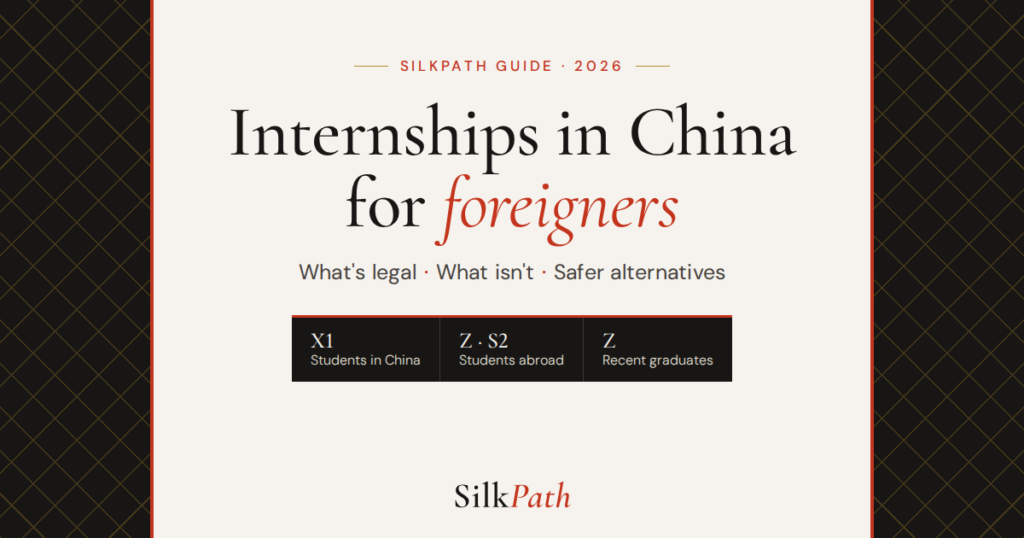
- You study at a Chinese university (X1 student visa): you can intern off campus once your residence permit carries an official “internship” remark.
- You study at a university abroad: you may be able to intern through a formal route, such as a residence permit marked “internship” under an inter-governmental or institutional programme, or an S2 visa with an internship remark in some pilot areas. Both depend on your host organisation and city.
- You have just graduated: you are no longer an intern in the eyes of the law. You need a regular work permit, although recent master’s and PhD graduates from Chinese or well-known overseas universities can qualify without two years of experience.
Everything else (interning on a tourist visa, visa-free entry, or a business visa) is illegal employment, paid or not.
Why an internship counts as work in China
China’s Exit and Entry Administration Law says that foreigners who work in China must hold a work permit and a work-type residence permit, and that employers must not hire foreigners without them. The law lists as unlawful employment working without these permits, working beyond their scope, and foreign students working in breach of the rules on student work.
The penalties are real: a foreigner working illegally can be fined RMB 5,000 to 20,000, detained for 5 to 15 days in serious cases, and deported, which usually comes with a ban on re-entering China. The company that employs them can be fined RMB 10,000 per person, up to RMB 100,000.
“Unpaid” does not change this. What matters is the activity and your visa, not whether you receive a salary.
Route 1: Students at a Chinese university (X1 visa)
If you are enrolled in a degree programme at a Chinese university with an X1 visa and a study residence permit, off-campus internships are possible within limits:
- your university must approve the internship;
- the internship should be related to your major and fit your study schedule;
- the local exit-entry office adds an “internship” remark to your residence permit. Without this remark, an off-campus internship is illegal;
- the remark is only valid for the period approved, so agree on your start and end dates with the company before you apply;
- universities and cities set further limits. For example, one Shanghai university’s rules (2019) limit internships to six months, unpaid apart from reasonable meal and transport allowances, and one company at a time.
The application process: find the host company, get the internship agreement and the company documents, apply through your university’s international student office, then file at the exit-entry office with your passport and residence permit before you start. The documents required and the processing time differ between cities, so ask your university for its current procedure, and do not start until the remark is on your residence permit.
Route 2: Students at a university abroad
This is the hardest case, and the one where most illegal “internship programmes” operate. The legal options depend on how and where the internship is organised:
- Residence permit marked “internship”: foreign students enrolled abroad can come to China on a Z visa for internships organised under inter-governmental agreements or approved programmes, and then apply for a residence permit marked “internship”. As for any Z visa, the visa application is made at the Chinese embassy, consulate or visa centre in your country, with your passport and the documents issued for the programme. This normally goes through an official exchange scheme, your university or a large organisation, not an individual company’s invitation.
- S2 visa with an internship remark (pilot areas): some pilot areas, notably Shanghai, Beijing’s Zhongguancun and the Guangdong Free Trade Zone, have allowed students from overseas universities invited by local organisations to intern on an S2 visa, with an internship remark added after arrival. These pilot rules have changed several times, so check with the host organisation and the local exit-entry office before relying on them.
Questions to ask any company or agency offering you an internship in China:
- Which visa will I enter on, and which document will show that my internship is authorised?
- Who applies for the internship remark or permit, and in which city?
- How long is the processing time, and when can I legally start?
- Has the company hosted foreign interns legally before?
If the answer is “come on a tourist visa” or “visa-free is fine”, walk away.
Route 3: Recent graduates
Once you have graduated, you can no longer use student routes. You need a work permit and a Z visa, like any foreign employee, even if the role is called a “trainee” or “graduate trainee” position. The usual rule asks for two years of relevant work experience, which shuts out most graduates, but there are exceptions:
- Since 2017, recent master’s and PhD graduates from Chinese universities, and from well-known universities abroad, can apply for a work permit without two years of experience if they apply within a year of graduating and have good grades.
- Some cities, including Shanghai, have their own schemes for foreign graduates of local universities.
Our step-by-step guide explains how to get a work visa in China, and our guide to getting a job in China as a foreigner covers the job search itself.
The routes at a glance
| Your situation | Legal route | Key condition |
|---|---|---|
| Student at a Chinese university | X1 visa + “internship” remark on the residence permit | University approval, related to your major |
| Student at a university abroad | Residence permit marked “internship” under an approved programme, or S2 + remark in some pilot areas | Organised by an official scheme or a host in a pilot area |
| Recent master’s or PhD graduate | Work permit + Z visa | Within a year of graduation, good grades |
| Bachelor’s graduate | Work permit + Z visa | Usually two years of experience, or a local graduate scheme |
| Tourist, visa-free or business visitor | None | Interning is illegal employment |
Legal alternatives to an internship in mainland China
- A remote internship with a China-focused company or team, done from your home country. You gain the experience without immigration risk, and some companies later sponsor a work permit.
- Hong Kong, Taiwan or Macao, which have their own immigration rules and, sometimes, internship or graduate schemes. See our Hong Kong guide and Taiwan guide.
- Programmes that send young professionals abroad, such as France’s VIE programme for young EU nationals. The posting is organised and the employer handles the permits.
- Studying in China first, then interning legally through Route 1.
- Thinking of an au pair year instead? Read is au pair legal in China first: there is no au pair visa on the mainland.
Browse current internships in Greater China on SilkPath, and always ask how the visa will work before you accept.
Before you apply for a visa: a checklist for interns
Whatever your route, the visa requirements follow the same logic as for other work visas in China: the host organisation or programme provides the invitation or approval, and you apply for a visa at the Chinese embassy, consulate or visa centre that serves your nationality or place of residence. Expect to provide supporting documents such as your passport (check its validity against the length of your stay), proof of enrolment or graduation, and the documents issued for your programme. Processing times differ between embassies and between cities, so ask for written confirmation of each step before you book flights.
Recent graduates who move to a regular work permit will usually need a criminal record check: see our guide to the China criminal record check and apostille. If you are weighing Hong Kong instead, our Hong Kong summer internship 2027 guide explains the No Objection Letter and the application calendar, and the Hong Kong work visa guide covers IANG and the General Employment Policy. To compare living costs before you commit to a city, read Shanghai vs Chengdu cost of living, and to find openings, our list of job boards in China for foreigners.
FAQ
Is there an internship visa in China?
No. There is no general internship visa. Internships are allowed only through specific routes: students at Chinese universities with an internship remark on their residence permit, and certain organised programmes or pilot schemes for students abroad.
Can I do an unpaid internship in China on a tourist visa?
No. Interning on a tourist visa, a business visa or visa-free entry is unlawful employment, even if it is unpaid.
Can I intern in China during visa-free entry?
No. China’s 30-day visa-free entry covers business, tourism, family visits, exchanges and transit. You can visit a company or attend an interview, but you cannot work or intern.
How long can an internship in China last?
It depends on your route and city. Some universities cap student internships at six months, and a residence permit remark is only valid for the period approved.
Can a company in China sponsor my internship?
A company can host you, but it cannot create a visa route that does not exist. Ask which visa and which permit it will use, and check that they match one of the routes above.
Sources
- Exit and Entry Administration Law of the PRC, Articles 41, 43 and 80 (work permits, unlawful employment, penalties), official English text, National Immigration Administration: en.nia.gov.cn
- EU SME Centre, “Is it possible to hire foreign interns in mainland China?” (X1 route, residence permit marked “internship” for students abroad): eusmecentre.org.cn
- China Briefing (2019), “How to Hire a Foreign Intern in China” (internship remark, S2 pilot areas): china-briefing.com
- Donghua University, Shanghai (2019), internship visa regulations for international students: cip.dhu.edu.cn
- China Briefing (2017), work permits for foreign master’s graduates without work experience: china-briefing.com
- State Council of the PRC (Xinhua, 4 November 2025), visa-free entry until 31 December 2026: english.www.gov.cn