In short
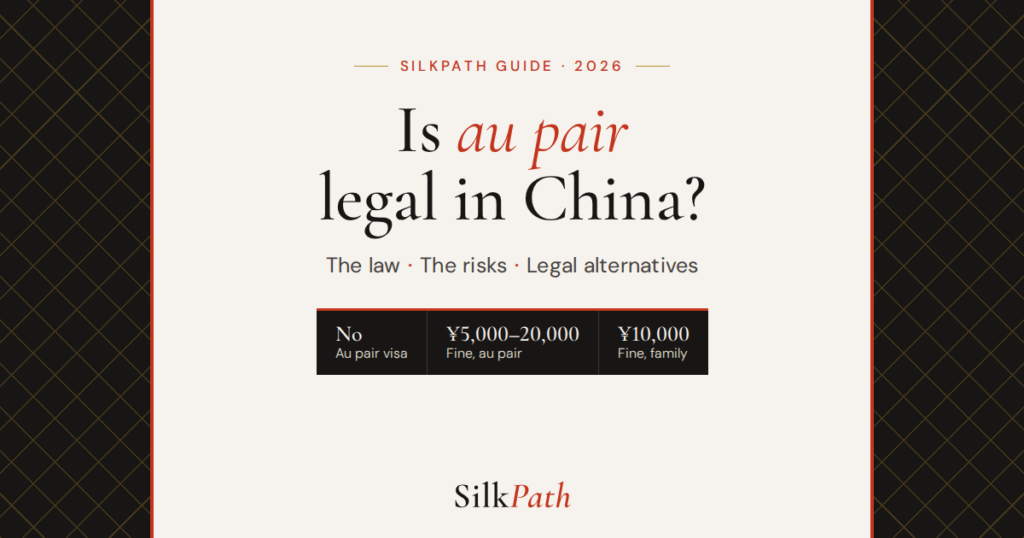
In mainland China there is no au pair visa and no au pair status in the law: childcare in exchange for pocket money, a room and meals is likely to count as work, which requires a work permit and a Z visa. Tourist, F (exchange) and student visas do not allow it. A foreigner working illegally can be fined RMB 5,000 to 20,000, and the family that hosts them RMB 10,000. Legal alternatives include studying on an X1 visa, teaching with a work permit, or a working holiday in Hong Kong or Taiwan.
Last updated: 19 October 2026. This guide is based on China’s Exit and Entry Administration Law and on the regulation that lists China’s visa types. It is general information, not legal advice: confirm your own case with the Chinese embassy or visa centre in your country before you travel.
Is au pair legal in China? In mainland China, there is no au pair visa and no au pair status in the law. Looking after a family’s children in exchange for pocket money, a room and meals is very likely to be treated as work, and work requires a work permit and a Z visa. Most au pair placements in China rely on a tourist, exchange or student visa, and none of those allows you to work. The risk is real: fines of RMB 5,000 to 20,000 for the au pair, and a fine of RMB 10,000 for the family that hosts you.
That does not mean you have to give up on living with a Chinese family or discovering China young. It means choosing a route that is legal. This guide explains what the law says, why the usual au pair visas do not fit, and the legal alternatives.
Is au pair legal in China? What the law says
China’s Exit and Entry Administration Law is short on this point. Foreigners who work in China must hold a work permit and a work-type residence permit, and “no entities or individuals shall employ foreigners” without them (Article 41). Working without these permits is listed as illegal employment (Article 43).
The penalties are set out in Article 80:
- the foreigner who works illegally can be fined RMB 5,000 to 20,000, and in serious cases detained for 5 to 15 days;
- the individuals or entities that employ them can be fined RMB 10,000 per person, up to RMB 100,000.
The law does not mention au pairs at all, and it does not ban au pair agencies: an agency can be a properly registered company offering matching, classes and support. The open question is the visa status of each au pair. Two words matter here. First, the law says “individuals”, not only companies: a host family can be fined. Second, the law has no special category for cultural exchange work. Many agencies describe au pairing as an exchange rather than a job, but Chinese law does not recognise an au pair status, so childcare in return for pocket money, board and lodging is likely to be treated as work.
Which visa do au pairs use, and why it does not fit
China’s ordinary visas are listed in Article 6 of the Regulation on the Administration of the Entry and Exit of Foreigners. None of them is an au pair or domestic-helper visa. The visas usually mentioned for au pairs are these:
| Visa | What it is for, according to the regulation | Can an au pair work on it? |
|---|---|---|
| L (tourist) | Tourism | No |
| F | Exchanges, visits, study tours and similar activities | No: it is not a work visa |
| X1 / X2 | Long-term or short-term study | Not as a job: with an X1 study residence permit, only a work-study or internship approved by the school and noted on the permit (Article 22) |
| Visa-free entry | Business, tourism, family visits, exchanges and transit, up to 30 days | No |
| Z | Work in China | Yes, but it needs a work permit, which au pair placements do not provide |
The student route deserves a closer look, because some programmes combine Mandarin classes with an au pair placement. Under Article 22 of the regulation, a foreigner with a study residence permit may not do any off-campus work-study or internship unless the school agrees and the place and duration are written on the residence permit. We found no official rule that treats au pair childcare as an approved work-study, so ask your university in writing before you accept a family.
In practice, au pair programmes in China are built as cultural exchanges: au pairs receive pocket money, not a salary, and many are enrolled as students on a regular X1 visa. That is the most defensible set-up, and it is very different from a full-time nanny job paid like a salary, which is clearly work. But Chinese law sets no amount below which childcare stops being work: on a student visa, any off-campus work-study still needs your school’s approval and a note on your residence permit.
What can happen to an au pair in China
The law does not distinguish between a well-meaning au pair and any other illegal worker. In practice, the risks are:
- Fines of RMB 5,000 to 20,000, and detention in serious cases.
- Deportation, which usually comes with a ban on re-entering China and can end a future career there.
- A fine for your host family, which puts your relationship with them at risk.
- No protection. Without a legal contract, you have no recourse if the family changes the deal, keeps your passport or ends the placement early.
Not every au pair is checked. But “it usually goes fine” is not the same as “it is legal”, and the person who pays is you.
Legal alternatives to an au pair year in China
If what attracts you is living in China, learning Mandarin and being close to a Chinese family, there are legal ways to do it.
- Study in China first. An X1 student visa lets you live in China for a full degree or a long language programme. During your studies, you may do an internship that your university approves and that is noted on your residence permit. Our guide to internships in China for foreigners explains the rules.
- Teach English legally. If you have a bachelor’s degree and a passport from a native English-speaking country, a school can sponsor your work permit and Z visa. Read teaching English in China in 2026.
- Hong Kong’s Working Holiday Scheme. If you are 18 to 30 and from one of its 13 partner countries (including the UK, France, Germany, Ireland, Canada, Australia and New Zealand), you can stay up to 12 months and take temporary work, within limits that depend on your nationality (often three or six months with the same employer). See the Hong Kong work visa guide and the Hong Kong visas guide.
- Taiwan’s working holiday schemes. Taiwan has working holiday arrangements with a number of countries, generally for people aged 18 to 30. Check the list on the Bureau of Consular Affairs website and our Taiwan visas guide, or read teaching English in Taiwan.
- A legal job after your degree. When you are ready to work, our guides explain how to get a job in China as a foreigner and how to get a work visa in China, starting with the criminal record check and apostille.
Questions to ask any au pair agency or family in China
If you are still considering a placement, ask these questions and get the answers in writing:
- Which visa will I enter on, and which document allows me to look after children in China?
- Who has checked that this is legal, and can you show me the official rule?
- What happens if the police check my status, and who pays a fine?
- Will anyone hold my passport?
If the answer is “everyone does it” or “come on a tourist visa”, you have your answer.
Already an au pair in China?
If you are in China on a tourist, exchange or student visa and looking after a family’s children, do not panic, but do not stay in a grey zone either. Stop before your situation gets worse, talk to your university if you are a student, and plan a legal next step: a study programme, a teaching job with a proper work permit, or a working holiday in Hong Kong or Taiwan. Browse current internships and teaching jobs open to foreigners on SilkPath.
FAQ
Is there an au pair visa in China?
No. China’s list of ordinary visas has no au pair or domestic-helper category. Au pair placements usually rely on tourist, F (exchange) or student visas, and none of them allows you to work.
Can I be an au pair in China on a student visa?
Only within the rules for students. A study residence permit does not allow off-campus work-study or an internship unless your school agrees and it is noted on your residence permit. We found no rule that treats au pair childcare as an approved work-study, so ask your university in writing.
What is the fine for working illegally in China?
Under the Exit and Entry Administration Law, a foreigner who works illegally can be fined RMB 5,000 to 20,000 and, in serious cases, detained for 5 to 15 days. The person or company that employs them can be fined RMB 10,000 per foreigner.
Can a host family be fined for hiring an au pair?
Yes. The law says that individuals or entities that illegally employ foreigners can be fined RMB 10,000 for each foreigner, up to RMB 100,000.
Is being an au pair legal in Hong Kong or Taiwan?
Hong Kong and Taiwan have their own immigration rules, separate from mainland China. Both offer working holiday schemes for young people from partner countries, which are the clearest legal way to combine a long stay with some work. Check the official pages for your nationality.
Sources
- Exit and Entry Administration Law of the People’s Republic of China, Articles 41, 43 and 80, official English text, National Immigration Administration: en.nia.gov.cn
- Regulation of the People’s Republic of China on the Administration of the Entry and Exit of Foreigners (2013), Articles 6 and 22, English translation, China Justice Observer: chinajusticeobserver.com
- State Council of the PRC (Xinhua, 4 November 2025), visa-free entry until 31 December 2026: english.www.gov.cn
- Hong Kong Immigration Department, Working Holiday Scheme (page revised 9 February 2026): immd.gov.hk
- Bureau of Consular Affairs, Ministry of Foreign Affairs (Taiwan), visas and working holidays: boca.gov.tw