In short
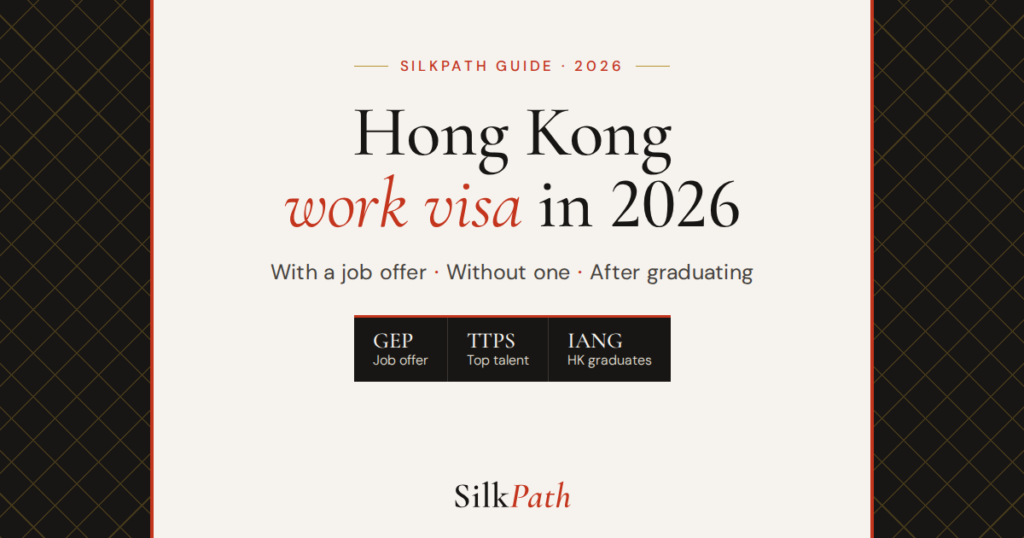
Most Westerners work in Hong Kong through one of three routes: the General Employment Policy (GEP), with a job offer from a Hong Kong employer; the Top Talent Pass Scheme (TTPS), without an offer, for high earners and graduates of listed top universities; or IANG, for graduates of Hong Kong universities. GEP processing normally takes four weeks once the Immigration Department has every document, and the first stay runs 24 to 36 months depending on the route. A Hong Kong work visa does not let you work in mainland China.
Last updated: 19 October 2026. Hong Kong’s immigration schemes are run by the Immigration Department (ImmD), whose criteria can change without notice and whose approval is discretionary. This guide summarises the official pages as they stood in October 2026: always check them before you apply.
Hong Kong has its own immigration system, separate from mainland China. A Chinese Z visa does not let you work in Hong Kong, and a Hong Kong work visa does not let you work in Shenzhen. Chinese embassies and consulates issue mainland visas such as the Z visa; Hong Kong work visas are approved by Hong Kong’s own Immigration Department. The good news for Western professionals: the Hong Kong work visa routes are clearer, faster and more open than the mainland’s.
This guide explains the three routes most Westerners use in 2026: the General Employment Policy (with a job offer), the Top Talent Pass Scheme (without one) and IANG (for graduates of Hong Kong universities), with the official criteria, the length of stay and how long it takes.
Hong Kong work visa routes at a glance
| Route | Job offer needed? | Who it’s for | Initial stay |
|---|---|---|---|
| General Employment Policy (GEP) | Yes | Professionals hired by a Hong Kong employer | Normally 36 months (or the contract, if shorter) |
| Top Talent Pass Scheme (TTPS) | No | High earners and graduates of listed top universities | 36 months (category A) or 24 months (B and C) |
| IANG | Only if you apply more than 6 months after graduating | Graduates of full-time degree programmes in Hong Kong | 24 months |
There are other schemes (for mainland Chinese residents, for technology talent, for investors, and working holidays for young people from partner countries), but these three cover most Western professionals.
1. General Employment Policy (GEP): the standard work visa
The GEP is the classic Hong Kong work visa, usually called the Hong Kong employment visa: a Hong Kong employer hires you, and you apply for a visa tied to that job. It has no quota and is open to all sectors.
According to the Immigration Department, an application may be favourably considered when:
- there is no security objection and no known record of serious crime;
- you have a good education background, normally a first degree in the relevant field (good technical qualifications or proven professional abilities can be accepted in special circumstances);
- there is a genuine job vacancy, and you have a confirmed offer for a role that cannot readily be filled by the local workforce;
- the pay and benefits are broadly in line with the market level for professionals in Hong Kong.
Stay: normally 36 months on employment condition (or the length of your contract if shorter), then extensions on a “3-2 year” pattern. Professionals who have worked under the GEP for at least two years with a taxable income of at least HK$2 million in the previous year can be considered for five years of stay without employment conditions.
Family members: your spouse or recognised partner and unmarried children under 18 can join you as dependants, with their own dependant visa application, and dependants can work or study in Hong Kong.
Processing time: the Immigration Department says processing normally takes four weeks once it has all the required documents and the fee.
Who cannot use the GEP: residents of mainland China (they have a separate scheme) and nationals of Afghanistan, Cuba and North Korea.
2. Top Talent Pass Scheme (TTPS): a visa without a job offer
The TTPS lets you move to Hong Kong without a job offer, then look for work once you are there. It has three categories:
- Category A: annual income of HK$2.5 million or more (or the equivalent in another currency) in the year before you apply.
- Category B: a degree from one of the eligible universities and at least three years of work experience in the past five years.
- Category C: a degree from an eligible university obtained in the past five years, with less than three years of experience. Category C has an annual quota, allocated first come, first served.
Stay: 36 months for category A, 24 months for categories B and C, with no other conditions of stay, which means you can work for any employer or start a business.
The list of eligible universities is published by the Immigration Department and updated regularly: check that your university is on it before planning around the TTPS.
3. IANG: for graduates of Hong Kong universities
If you complete a full-time degree programme in Hong Kong, the Immigration Arrangements for Non-local Graduates (IANG) let you stay and work after graduation:
- Within six months of graduating, you can apply without a job offer.
- After six months, you need an offer for a job commonly taken up by degree holders, at a market-level salary.
Both groups normally receive 24 months of stay without other conditions, and can take up and change jobs freely during that time. That makes a master’s degree in Hong Kong a real pathway into the local job market.
Which Hong Kong work visa is right for you?
- You already have a job offer from a Hong Kong company: the GEP, filed with your employer.
- You don’t have an offer yet, but you graduated from a top university or earn a high income: the TTPS, then job-hunt on the ground.
- You studied in Hong Kong: IANG.
- You are young and from a partner country: look at Hong Kong’s Working Holiday Scheme on the Immigration Department website for a first, shorter experience (age limits and quotas depend on your country).
How to apply for a Hong Kong work visa
The visa application process takes five steps, whichever route you use:
- Check the official page of your scheme on the Immigration Department website (criteria change). Each scheme has its own application form and list of supporting documents.
- Prepare your supporting documents: passport, degree certificates, proof of experience and, for the GEP, the employment contract and employer documents.
- Submit an online application through GovHK and pay the application fee. For the GEP, your employer provides its own documents and usually coordinates the application.
- Approval and e-Visa: once approved, you pay the visa issuance fee and receive an e-Visa.
- After arrival: if you are allowed to stay more than 180 days, you must apply in person for a Hong Kong identity card within 30 days of arrival.
- Before your stay ends: apply for an extension before your limit of stay expires. Your visa’s validity is tied to that limit, not to your passport or your contract alone.
Don’t start working on a visitor stay. Visitors to Hong Kong cannot take up any employment, paid or unpaid.
Finding a job in Hong Kong
On 15 October 2026, SilkPath listed 83 live roles in Hong Kong open to Western professionals, from summer 2027 internships at law firms to finance, tech and teaching roles. Browse jobs in Hong Kong, compare with jobs in mainland China and Taiwan, and read our Hong Kong guide on cost of living and working life.
Considering the mainland instead? Our guide explains how to get a work visa in China, which works very differently. And for the job hunt itself, see the best job boards in China for foreigners, including the main Hong Kong sites.
Before you apply: practical points for foreigners
A few points catch many foreigners out. You need a valid passport or travel document throughout the visa application, and you should keep copies of every application form and supporting document you submit. A visitor stay, whether visa-free or on a visitor visa, does not allow you to work, paid or unpaid, and that includes business visitors. Students have their own rules: if you study in Hong Kong, internships and summer work go through the No Objection Letter explained in our Hong Kong summer internship 2027 guide.
Comparing Hong Kong with the mainland? The mainland has a separate system: see how to get a job in China as a foreigner, internships in China for foreigners and the China criminal record check and apostille, which every mainland work permit requires. For Taiwan, read teaching English in Taiwan, and to budget a move to the mainland, Shanghai vs Chengdu cost of living.
FAQ
How long does it take to get a Hong Kong work visa?
Under the General Employment Policy, the Immigration Department says processing normally takes four weeks after it receives all the documents and the fee. Incomplete applications take longer.
Can I get a Hong Kong work visa without a job offer?
Yes, through the Top Talent Pass Scheme if you meet its income or university criteria, or through IANG within six months of graduating from a Hong Kong university.
Is a Hong Kong work visa valid in mainland China?
No. Hong Kong and mainland China have separate immigration systems. To work in Shenzhen or Shanghai, you need a Chinese work permit and Z visa.
Can my partner work in Hong Kong?
Under the GEP, recognised dependants (spouse or partner, and unmarried children under 18) can join you and are allowed to work or study.
What salary do I need for a Hong Kong work visa?
The GEP has no fixed minimum: the package must be broadly in line with the market for the role. The TTPS category A requires HK$2.5 million or more in annual income; categories B and C have no income threshold.
Sources
- Hong Kong Immigration Department, General Employment Policy (Professionals), page revised 16 April 2026: immd.gov.hk
- Hong Kong Immigration Department, Top Talent Pass Scheme: immd.gov.hk
- Hong Kong Immigration Department, Immigration Arrangements for Non-local Graduates (IANG): immd.gov.hk
- University of Hong Kong, notes for non-local students on the Hong Kong identity card (registration within 30 days of arrival for stays over 180 days): handbook.hku.hk
- SilkPath job board, live roles in Hong Kong on 15 October 2026: silkpath.org/jobs/hong-kong